Bukchon Hanok Village(북촌 한옥마을) in Seoul, South Korea
 

Bukchon Hanok Village(북촌 한옥마을) in Seoul, South Korea

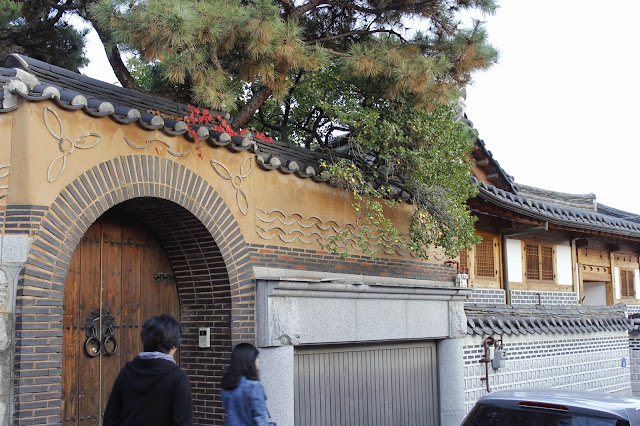
This is the actual residential area consisted of being concentrated Korean traditional Hanok (a kind of houses) village, the only one in Seoul, is the residential area of high-ranking government officials and nobilities during the Joseon-dynasty (1392-1897) also.
Bukchon village (literally meaning; north village) is located in between Gyeongbok palace(경복궁) and Changdeok palace(창덕궁), is uptown area from the Cheonggye stream and Jongno area. This is located so closely together also to Samcheonggil alley(삼청동길).

It is dated back to Iron’s age (over 1500 years ago) to use Ondol and Daecheong systems which is featuring point of this house in Korea. In 1930s Hanyang (former name of Seoul) had gotten high population due to crowded people from the rural area and became highly concentration in many aspects. It had caused many social and economic problems, especially in their residential side. The demand meets the supply as it is. Company dealing with residence management bought large land in this area and built Hanok village which had been improved in the style of it as before.
The size was smaller, glass door was installed at Daecheong, iron sheets was galvanized in its’ roof additionally to Cheoma (edge of Hanok’s curvy roofs), standardized wooden beam was used for its’ efficiency due to massive construction. New developed house of this style had been kept the characteristics of traditional house and been settled as a new type of urban house and showed luxurious decoration in particularly.
It needs natural materials to build this house. Tiled roofs baked soil, pine trees for timber, stone-blocks construction for Ondol of the bottom in room, Hanji(Korean traditional paper used for windows and doors, beautiful and breathable), and patterned wall costs many expense. Ondol(온돌) is a kind of floor-rock-based heating system by principle of convection phenomenon during cold winters, Daecheong(대청) is a cool wooden-floor style hall on the front porch which keeps the house cool. Cheoma(처마) on the roof is to control the amount of sunlight that enters the house during hot summer.
This is very expensive house to buy and to maintain. So ownership for this house means the symbol that owner is very rich and has the authority on many ways.
It is very interesting that early 1900s some of the church of Anglicanism catholic was built in Hanok for naturalization of their religion, in Ganghwado, Jincheon and Cheongju which are still there. In 1970s, architect who learned modern architecture regarded Hanok as outdated and inefficient one.
Besides, the propagation of complex type tenement housing and apartment caused the decreasing of the number of Hanok from 800,000 into 12000(today) in Korea so rapidly. Now a days as by Hanok has decreased it means Giwa house (tiled roof) in the public senses with reduction of meaning. Fortunately, the value of this house is refocused with its functional efforts eco-friendly and therapy for atopy and asthma caused by environmental factors and unique beauty of this house itself.

Reconstruction,gentrification, reservation efforts voluntarily is keep going on by area resident based on their opinions. Now it becomes to a street of traditional culture and art with unique styles mixing tradition and modernism, neighboring Insadong and Samcheongdong.
Some difficulties are still left. It is inconvenience on the space of the functional connection by user’s circulation system. The wall is not thick enough and has some crack causing chill atmosphere. Wooden timber is very expensive still and it is difficult to find out the skillful builder. Despite of these reasons, new attempt to improve their house is trying continuously too also. This area is always crowded by Korean and foreigners. So you might be miss real worth and just end with only taking photos. And you might be in some fear to lose your way between in many alleys. Don’t be afraid. This is uptown, so can easily reach the lower road which is starting point.
Kokdu museum for art craft made by wood
There are cultural center, guest houses, restaurant, and teahouse. Bukchon traditional culture center gives you an opportunity to experience, learn, and immerse in Korean traditional culture.

Tip ; This is residential area. Houses are not allowed to get inside to the public.
     You can just see through by restaurant, tea house, craft houses only.
     I want to recommend to visit the Bukchon traditional culture center at first.

     Bukchon traditional culture center >>>click here !!
  
Gwanghwamun Gate (광화문), Seoul, Korea
  

Gwanghwamun Gate (광화문), Seoul, Korea

This gate’s name means that great virtue of king lighten whole of the country.
 It is the south gate of Gyeongbokgung palace(경복궁) where kings of Joseon dynasty(1392-1897) lived and ruled the country as the primary old main palace. Gwanghwamun square (광화문광장) is in front of this gate. It is also starting point to measure the distance between Seoul and other local cities in this country.
It has three arched gates(Hongyemun;홍예문 middle one for king, others for officials), a pair of Haetae(해태) sculpture looking southward and mythical symbolic paintings on the ceiling with different one.
It was destroyed two times when Japanese invaded in 1592 and Korean war(1950) was broken out. It has gotten several disassemble and restoration through multiple periods.Despite of various hardships through long history, now it stood again in 2010 in a dignified manner just like Korean peoples’ spirit after being equipped with historical accuracy.
The Haetae(Haechi)
A pair of Haetae (or called by Haechi),symbolic guard animal, protect the palace from the fire. This is regarded as the fire guard which has a small horn on its forehead and a bell on its neck and symbol of justice and law also. So king wanted that officials resemble after this spirit and deal with the law without favour on the side of the angels.
You can see the Patrol changing ritual of the royal guard who wore the traditional guard uniform. Also there is a small place that you can experience firsthand for wearing their clothes inside the gate.
Experience of wearing the uniform of royal guard
As if it was there as long as ever along with Korean history this priceless gate is going to stand now and after forever.
How to get there ; take off Gyeongbokgung (Seoul subway line3) Exit #5


CSAT (College Scholastic Ability Test) of Korea

CSAT (College Scholastic Ability Test) of Korea

The test to evaluate the scholastic ability at the college, we call it Suneung (수능).
Photo ; Chosun-ilbo

It is amazing that the weather is always chill on this day precisely and suddenly. 
Photo ; mall of sweet 거위박스

Peoples by applicants’ side give them some presents for cheering. This is the “chocolate of Seoul-national university(서울대학교; the best university in Korea)” which has an initial and logo of this university, sell in their university store at first and is regarded as a good-luck charm and is selling like hot cakes.
Photo ; daegu-ilbo

Mother and grandmother are praying the excellent achievement for applicant at the front Buddha.   It is held 2nd Thursday in November every year by the KICE (Korea Institute of Curriculum & Evaluation) for the applicants who is the graduate-to-be, graduates and have at least a high school diploma or the equivalent. They are 60,000 over, which of 20% is repeater. There are the persons who failed the CSAT three times often. Sometimes over 70-years-old person has becomes in the news.
Old grandma applicant (Photo by The Korea Herald)

The high college entrance rate is up to 80%.The result are classified into the 9-grade by the way of Stanine which classify and assign them according to the regular distribution type. This is the standardized test accepted by South Korea universities officially. So this is very important test to a person who wants to go college or university future. Students have put their all efforts so much time and got feeling amount of pressure too.
For the late applicant and police(Photo by Korea JoongAng Daily)

On a that day, there are big bustling across the country that the applicants are assisted everything for their test taking like as follows; middle school & high school are closed, the office-going hour is delayed, government employees & elementary school students attend lately rather than as usual, stocks market is delayed one hour, more frequency of bus and subway, escort by policeman for the late attendees and banning of take-off and landing of airplane.Korea doesn’t have many natural resources. Therefore man-power is important one to develop this country. People think that good educational background, especially   focusing to intellectual equipment side rather than one’s own unique abilities gives them the chance to make or break one’s future. As far as this kind of conception continues, makes young student hard, it is unavoidable dark side of this test.
Good luck for the challengers !!!!!

This post contains affiliate links, which means we offer all travelers to sales benefits if you purchase after clicking.  Thank you for your support.

Samcheongdong-gil & Samcheong park(삼청동길 & 삼청공원) in Seoul

Samcheongdong-gil & Samcheong park(삼청동길 & 삼청공원) in Seoul


Do you have an image that The Seoul city is just only filled with full of modern complex capital flavor of Korea? I dare tell you confidently that is wrong in many ways if you have like that. Don't hesitate to stop over this unique and beautiful new cultural combination in the side of between old and new place in the bustling downtown in Seoul city. What's more,it is located in the just next to the famous Gyeongbokgung palace( 경북궁,the main royal palace of the Joseon Dynasty) and Korea traditional Bukchon Hanok Village. So if you are planning to visit this great palace or village, don't miss this attractive spot also.
This area has been very calm,comfortable residential area which consisted of the middle class people since long times ago. And along with the road some vintage, tiny, cozy shops show their own flavor over the years. So many young lovers has been leaded steadily into this road as an attraction must to visit together. This road has been loved as the representative symbol of romantic walking street. From few decades ago, there were new aggressive attempt to put on modern culture color into the old and faded houses and alleys. With those efforts now here became another hot place leading trend with various beauty brand shops, fashion brand shops, new living specimen shops, cafes and dessert shops.So you can see the unique signs which make your sense light on with a variety of way.With various art galleries and museums which be seen easily here boasts not only just shopping area but also smart art place.
Book cafe
Open stage, they are performing 'Waiting for GoDot'
Chocolate shop
The Mole Market which is vintage and reform store
Cafe wears new clothes on the traditional house
This is not the everything of this lovely place.  At the end of this road you are able to reach the tiny and cozy park like another bonus one to you. It is Samcheong park.

Samcheong park(삼청공원)
The name of "Samcheong" is originated from the side of  Taoism thought. It means three Taoist hermits with miraculous power. In the past Joseon dynasty there was a shrine in here to worship three gods. So people called here by this name. According to another opinion this is the place where is clean in water, mountain and people (literally; three blue).
The cozy library within the park
The Poet and The Poem on the stone
This is the first officially designated urban park in Korea (1940).Many people are crowded every year in April to see the splendid cherry blossoms. This is a park where people can see easily beautiful foliage in the midst Seoul and loved also in fall. And various amenities are equipped here and there like as badminton court, tennis court, children playground and library also.
As there are many unique shops on the streets of Samcheong-dong, there are some people who turn away their feet at the entrance of this beautiful park locates at the end of this street. But in a way that's missing the hidden gem. I am convinced that this park will give you another pleasure. Don't you agree that trips sometimes must need quiet time?
Don’t miss this park. 
near the alley of Deoksung girls' high school(덕성여고)
 

The regional specialty of Ganghwa-Island (Ganghwado 강화도), South Korea
 

The regional specialty of Ganghwa-Island (Ganghwado 강화도), South Korea

Ganghwado is located in west of Seoul, connected with two bridge which means it is not island like their name any more.
The Ginseng (Insam 인삼)
Ginseng (Panax Ginseng) has been used widely for folk medicine for over 2000 years. Emperor Qin Shi Huang of China regarded it as medicine of eternal youth. And also to the western general public it was called as “Treasure from the Orient”. The name of Ginseng ( Insam ; 인삼) is derived from the shape resembling the legs of a person. It grows especially in cold climate zone, North America, Eastern Asia (Korea, China,Bhutan, eastern Siberia). Full-scale cultivation of Ganghwado area has been started 1953 after Korean-war(1950-1953) by whom refugees from Gaeseong (North Korea, Traditional area of ginseng from Goryeo dynasty). It’s market sails amount is up to nearly $ 2.1 billion, 35 countries, of which half is Korean Ginseng. The China is the biggest consumer.

6-years-grown Red ginseng is the most loved one among the other kinds of it (classified by the treatment; fresh ginseng, red ginseng, white ginseng). People take it as the type of oriental medicine, energy drinks, herbal teas, and so on. It boosts immune system, provides energy, improves concentrating & learning, prevents fatigue, contains phytoestrogen, and has some effect to a men erectile dysfunction. It causes often side effects despite of their well-known qualities according to human constitution. So you need some cautions, especially to the person becoming hot temperature easily.

The Hwamunseok(화문석)
The name has the meaning of mat decorated with flowers.This is the rush-weaving handicraft and the cultural legacy inherited from ancient Goryeo dynasty (AD918-1392) exclusively.The tall flat white sedge, material used for this mat, grows only in this island in the past.The mat can be possible to keep the body cool in summer and against chill of weather in winter. It is glassy, unbroken, and durable. People placed a piece of mat in the living room for their naive, exquisite, elegance design and air-cooling in summer. It took 7 days with 2-3 persons at least to make it due to intricate patter (size 2 M x 3 M). So price is some high also.There were so many houses to make this mat 30 years ago. But now 10 houses barely keep itself in existence because this kind of mat was imported at a low price from the south east asia since 1990s'. Cheap products made in China and Vietnam, westernization of life style (sitting>standing), lack of rural resource caused rapid decrease of this industry.
The handy craft made from white sedge 
The Soonmu(a kind of turnip 순무)
This is a turnip grows in Ganghwado only, deep-purple skin, white inside. Korean soonmu is white originally.In 1893, W.H.Callwell, a military instructor of navy from England, brought their native turnip and cultivated at first. As times go by it mixed with origin Korean one. It’s harder than as usual one and has mustard-like aroma. It is good for helping digest, diminishing hang-over, combating liver illness, and brightening of ear and eye. People use to make kkadugi (깍두기; sliced radish Kimchi) in general only.  The recipe about this radish is not quiet well to the public. This can be preserve up to 2 years, but it doesn’t popular due to high price because of the low production rate per unit.


AnYang-city, GyeongGi-do,South Korea

AnYang-city, GyeongGi-do,South Korea

 The Just Comfortable and liberal city.
Harmony with human and nature.


Yep, this is the correct meaning of AnYang-city(안양시).
Long long times ago ancient era (Goryeo dynasty)
a king saw the five-colored cloud when he passed this area.
 He let the priest build a temple and named it “AnYangSa(Anyang-temple)”
So this has the name of AnYang-city naturally after that.
From prehistoric age, people had lived here according to the remaining relics.
This area is bounded with many cities, Seoul, Incheon, Suwon, and so on.
So it is able to easily access to neighboring cities in public resources.
They had engaged in agriculture for a long time as before
 which was planned urbanization by government policy in 1990s.
Seoul got more and more population as industries continued rapidly and became internationalized widely. So new cities which located near the suburb of Seoul were need for the people who walk in Seoul. Here is the one of cities composed in purpose according to that project.

  
 Anyang-city has a harmony with new city zone (Pyungchon area) and old city zone.

Can you imagine a city that is so well composed everything having good nature? Now it becomes big city where over 600,000 people live and keep on going to develop.
 Central park( JungAng-gongwon; 중앙공원) may be the best love zone of this city where people go throughout the year. The road use to be closed on weekend and open to the citizen to enjoy the bicycle and inline skating, and open flea market on a fine day also. On special memorial day or citizens day of Anyang city many people use to rush into this park and celebrate it.
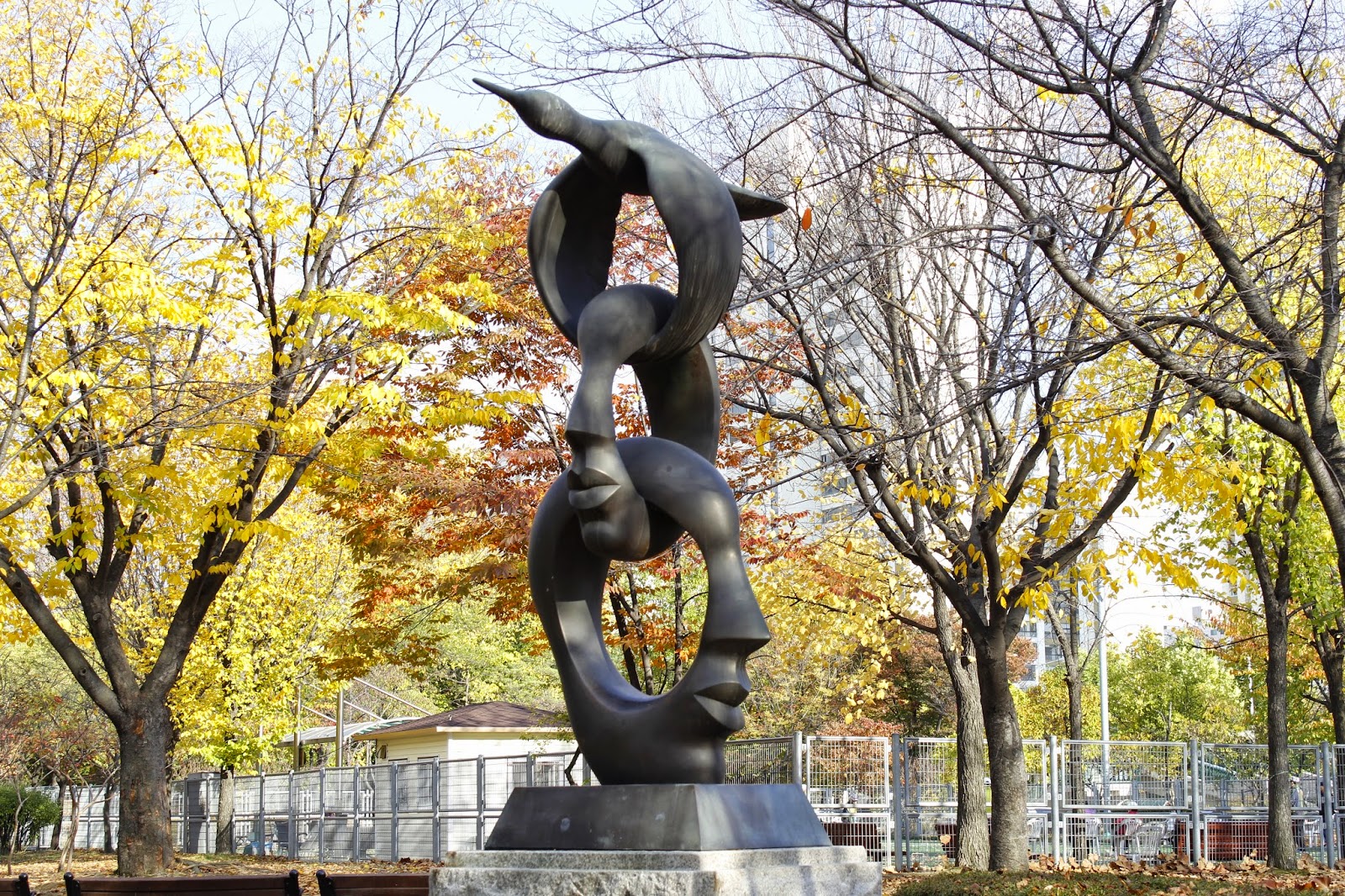
It seems like small open art gallery with their sculpture scattering here and there.
Sport facilities, tennis court, roller skating court, basketball court and others …
Anyang art park(예술공원) which locates in old city zone is also another favorite place which can feel nature.
                         Local team of  AnYang-city  KT & G Knight Baseball team

                               Local team of  AnYang-city  Halla  Ice Hockey team


How to get there ; take Seoul Subway Line4
                              off at Beom-Gye(범계), Exit 2 > walk 10mins--better choice
                         or off  at Pyeong-Chon(평촌), Exit 1 >walk 10mins